
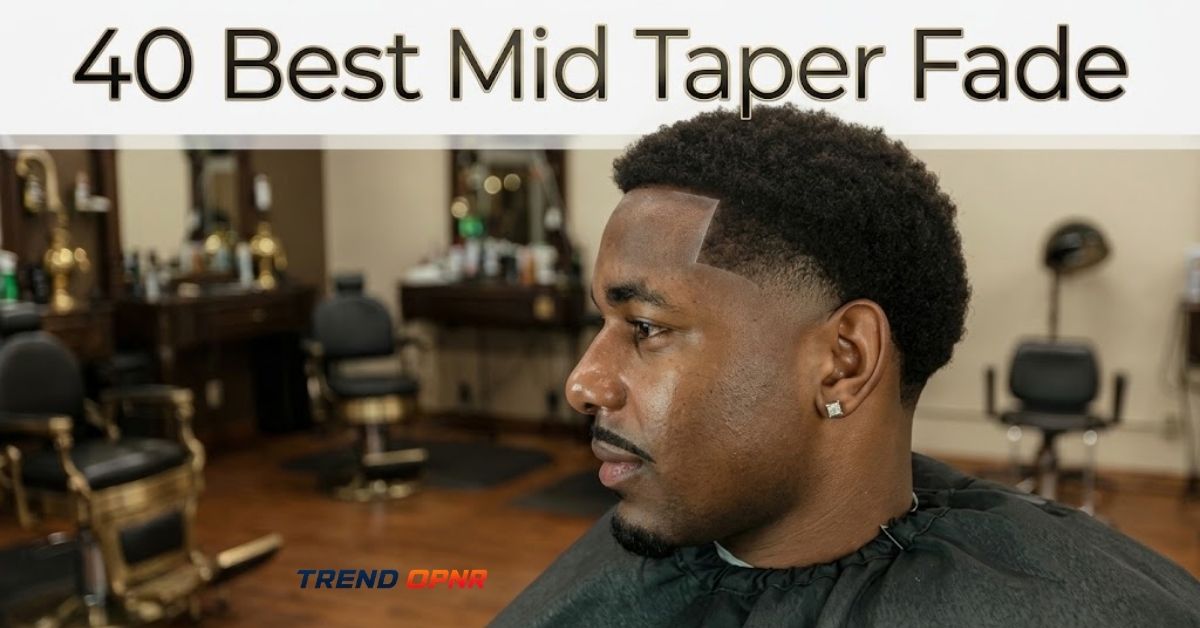

A well-executed Mid Taper Fade Styles haircut gives Black men a clean transition without taking away the character of natural texture. The look can be adapted to short cuts, afros, curls, waves, braids, locs, beards, and design-focused barbering.
This guide covers 40 practical variations, with attention to hair types, face shape, top length, maintenance, barber communication, products, and styling technique. The central idea is simple: preserve the top texture you like while creating a controlled fade transition around the temple, sides, back, and neckline.
What Is a Mid Taper Fade for Black Men and Why Does It Work So Well?
A Mid Taper Fade Styles cut places the fade beginning around the temple, usually about 1–2 inches above the ear, before blending downward toward the sideburns and neckline. Compared with a low taper fade, it creates more visible structure while remaining less dramatic than a high taper fade.
For Black men, the placement works especially well with Afro-textured hair because the barber can follow the natural growth direction rather than forcing the hair into an unnatural shape. Coily hair, kinky hair, and dense natural hair can retain substantial volume above the fade.
KEY POINTS:
- The mid taper fade creates moderate contrast rather than automatically producing a skin-level finish.
- It can complement 3C, 4A, 4B, and 4C hair when the blend respects natural texture.
- The top can remain short, medium, long, curly, twisted, braided, or locked.
- A clean edge-up can make the haircut appear sharper between appointments.
- Face shape should influence the amount of top volume.
- A barber should account for shrinkage before deciding the final hair length.
What is a mid-taper fade?
A Mid Taper Fade Styles haircut gradually reduces the length around the temple, sides, and back while leaving more length through the top section. The fade placement generally sits between a low taper and high taper, giving the haircut a balanced silhouette.
A taper reduces length progressively, while a fade usually creates a stronger transition toward very short hair. A taper fade combines these ideas. The exact result depends on guard numbers, clipper lever position, hair density, hair texture, and whether the client wants a near-skin or more closely cropped finish.
The fade beginning should be discussed before cutting. Some clients want the transition to begin exactly at the temple, while others prefer a slightly lower or higher interpretation. A good barber will also inspect the parietal ridge, crown, neckline, sideburns, and natural hairline before setting the guideline.
Mid Taper Fade vs Low Taper vs High Taper: What’s the Real Difference?
The biggest distinction between a low taper fade, mid taper fade, and high taper fade is fade placement. A low taper stays closer to the ear and nape, a mid taper reaches the temple area, and a high taper climbs farther upward toward the parietal ridge.
| Feature | Low Taper Fade | Mid Taper Fade | High Taper Fade |
| Fade beginning | Lower around ear and sideburns | Around temple | Higher toward upper sides |
| Visual effect | Subtle | Balanced | Bold |
| Contrast | Moderate-low | Moderate | High |
| Best use | Conservative haircut | Versatile haircut styles | Statement haircut |
| Typical refresh | 3–4 weeks | 2–3 weeks | 1–2 weeks |
| Top compatibility | Short to long | Almost any length | Short to dramatic |
The low taper is useful when someone wants minimal change to the sides. The mid taper creates a stronger frame around the face without removing as much visual weight as a high taper. A high taper produces more contrast and can make a tall top section look even more pronounced.
This is why taper vs fade conversations should focus on the desired silhouette rather than simply asking for a “clean fade.” A barber can use a taper, fade, or combination according to the client’s hair texture and preferred finish.
Why the Mid Taper Fade Works So Well for Black Hair
A Mid Taper Fade Styles haircut works particularly well with Black hair because the transition can frame natural texture instead of competing with it. Afro-textured hair often has considerable density and shrinkage, so keeping enough length on top allows the haircut to show the natural curl pattern.
With 4A hair, spiral coils can provide visible definition. With 4B hair, the zig-zag coil pattern can create dense volume. With 4C hair, maximum shrinkage can make the top appear much shorter when dry, so a barber should judge hair length in its natural state.
The hair shaft and follicles also deserve consideration. Very close cutting may reveal more scalp than the client expects, especially when hair density is low. Someone with fine hair or sensitive skin may prefer a closely cropped finish rather than an aggressive skin fade.
Which Mid Taper Fade Styles Work Best for Your Hair Type?
| Hair type | Typical characteristic | Suitable styling direction |
| 3C | Corkscrew curls and high definition | Defined curls, curly crop, pompadour |
| 4A | Spiral coils and noticeable shrinkage | Sponge twists, twist-out, rounded afro |
| 4B | Dense zig-zag coils | High top, blowout, frohawk |
| 4C | Tight coils and high shrinkage | Short afro, waves, sponge texture |
Hair types should never be treated as rigid rules. Two people with the same curl classification can have different hair density, hair length, porosity, growth direction, and preferred styling routine.
For coarse hair, a hot towel pre-treatment can soften the hair shaft before clipper work. A barber can then make fewer aggressive passes while maintaining a cleaner blend. The goal is not to force every texture into the same finish but to use barbering technique that respects the natural pattern.
40 Best Mid Taper Fade Styles for Black Men
The following list expands the competitor’s original 35-style structure to 40 options. Each variation considers face shape, hair texture, maintenance, styling, and what to tell your barber.
Short Hair Mid Taper Fade Styles
Short Mid Taper Fade Styles are usually the easiest to maintain. They work especially well for clients who want a professional haircut, youthful haircut, or modern haircut without spending a long time styling the top.
1. Buzz Cut with Mid Taper Fade
A buzz cut keeps the top uniform while the sides receive a controlled taper. The short length makes the haircut practical for busy schedules and highlights facial structure.
- Face shapes: Oval, square, round, heart
- Hair types: 3C through 4C
- Hair length: Short
- Maintenance: Low
- Guard numbers: #1–#3 on top with a shorter base
- Product: Light moisturizer
- Barber request: “Keep the top even and create a moderate temple taper with a clean hairline.”
2. Low Afro with Mid Taper Fade
A low afro provides enough natural volume to show texture without becoming a full afro. The sides stay controlled while the top retains a rounded shape.
- Face shapes: Oval, round, heart
- Hair types: 3C, 4A, 4B
- Maintenance: Low-medium
- Product: Leave-in conditioner and curl cream
- Styling: Pick the top gently rather than over-combing it
- Barber request: “Keep the top rounded and natural while cleaning the temple and neckline.”
3. Textured Crop with Mid Taper Fade
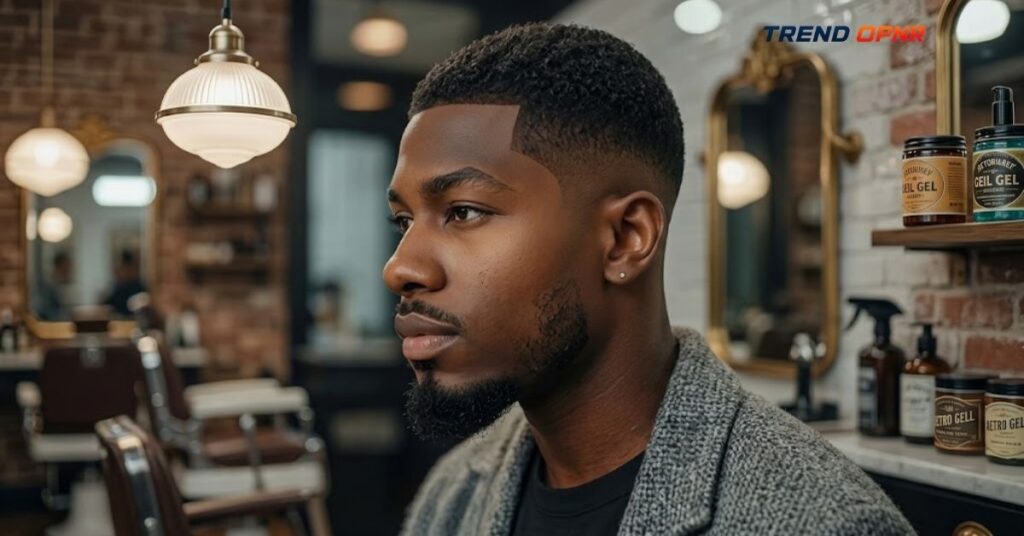
The textured crop gives short hair a defined surface without requiring significant length. It suits people who want a modern haircut with restrained volume.
- Face shapes: Oval, square, diamond
- Hair types: 3C, 4A
- Maintenance: Low
- Product: Texture clay
- Styling: Use the fingers to separate the texture
- Barber request: “Leave enough texture on top and keep the sides clean with a gradual blend.”
4. French Crop with Mid Taper Fade
The French crop places the fringe forward while keeping the sides and back controlled. On coily hair, the fringe can be kept natural rather than pressed flat.
- Face shapes: Oval, round, square
- Hair types: 3C, 4A
- Maintenance: Low-medium
- Product: Moulding paste
- Styling: Shape the fringe forward
- Barber request: “Keep the front textured and create a smooth temple-to-neckline transition.”
5. Caesar Cut with Mid Taper Fade
The Caesar cut gives the forehead a defined horizontal outline. It can be particularly useful for low-density hair because a consistent top length creates a visually uniform surface.
- Face shapes: Oval, oblong, heart
- Hair types: Most hair textures
- Maintenance: Low
- Product: Light pomade
- Barber request: “Keep the top short and even with a controlled taper around the temple.”
6. Crop Top Fade with Mid Taper
This haircut combines a compact top with sharp side structure. It is useful when someone wants the visual cleanliness of a fade without sacrificing all natural texture.
- Face shapes: Oval, square, round
- Hair types: 3C, 4A, 4B
- Maintenance: Low
- Product: Texture clay or styling cream
- Barber request: “Keep the top compact and textured and make the transition smooth around the temple.”
7. 360 Waves with Mid Taper Fade
360 waves depend on consistent wave formation, brushing, and compression. The taper should protect the circular wave pattern rather than cutting into its direction.
- Face shapes: Oval, round, square
- Hair types: 4A, 4B, 4C
- Maintenance: Medium
- Styling: Consistent brushing and overnight durag use
- Product: Wave cream
- Barber request: “Clean the sides without disturbing the wave pattern or wave direction.”
8. Side Part with Mid Taper Fade
A side part creates a polished silhouette and can make the haircut appropriate for an office-appropriate hairstyle. The part may be natural or defined by the barber.
- Face shapes: Oval, oblong, heart
- Hair types: 3C, wavy hair, straighter textures
- Maintenance: Low-medium
- Product: Medium-hold pomade
- Barber request: “Keep the part clean and blend the sides gradually without removing too much top length.”
Afro Mid Taper Fade Styles for Black Men
Afro variations allow the top to become the main visual feature. The haircut works particularly well when the barber respects natural shape, natural volume, and hair movement.
9. Classic Afro with Mid Taper Fade
The classic afro creates a rounded silhouette with the sides brought under control. It is a natural hairstyle that lets Afro-textured hair remain the focus.
- Face shapes: Oval, round, heart
- Hair types: 4A, 4B, 4C
- Maintenance: Medium
- Product: Leave-in conditioner and curl cream
- Tool: Afro pick
- Barber request: “Preserve the rounded afro shape while cleaning the temple and neckline.”
10. High Top Afro with Mid Taper Fade
The high top adds vertical height and can create a strong structural silhouette. It works particularly well for round faces but may exaggerate a long face.
- Face shapes: Round, oval
- Avoid: Very long or oblong faces if excessive height is undesirable
- Hair types: 4A, 4B, 4C
- Hair length: Several inches of healthy top growth
- Maintenance: High
- Tools: Scissors, comb, blow dryer
- Barber request: “Build height through the top while keeping the sides balanced.”
11. Mini Afro with Mid Taper Fade
A mini afro offers natural texture without requiring the length of a full afro. It is a strong choice for someone who wants a low-medium maintenance haircut.
- Face shapes: All
- Hair types: 4A, 4B, 4C
- Maintenance: Low-medium
- Product: Curl cream
- Styling: Gentle picking and moisturizing
- Barber request: “Keep the top compact and rounded with clean temple definition.”
12. Sponged Afro with Mid Taper Fade
The sponged afro creates small coils across the top using a hair sponge or curl sponge. It adds definition while preserving natural movement.
- Face shapes: Round, oval, heart
- Hair types: 4A, 4B, 4C
- Maintenance: Medium
- Product: Curl activator
- Tool: Hair sponge
- Barber request: “Keep the top long enough for sponge definition and make the sides progressively shorter.”
13. Afro Hawk (FroHawk) with Mid Taper Fade
The FroHawk keeps a central strip of natural hair while the sides become more controlled. It is a design-focused cut for someone who wants a dramatic silhouette.
- Face shapes: Oval, oblong
- Hair types: 4A, 4B, 4C
- Maintenance: Medium-high
- Product: Styling cream or texture wax
- Barber request: “Preserve the central strip and create a clean, even transition on both sides.”
14. Blowout Afro with Mid Taper Fade
A blowout afro maximizes volume and emphasizes the natural shape of coily hair. A blow dryer and diffuser can help maintain the expanded silhouette.
- Face shapes: Round, oval
- Hair types: 4B, 4C
- Maintenance: Medium-high
- Product: Volumizing mousse
- Tool: Blow dryer and diffuser
- Barber request: “Keep the sides controlled while leaving enough length for a full blowout.”
15. Afro with Edge-Up and Mid Taper
An edge-up adds structural definition to a natural afro. The barber can use a T-outliner for precise lines and a straight razor only when appropriate for the client’s skin.
- Face shapes: All
- Hair types: 4A, 4B, 4C
- Maintenance: Medium
- Product: Edge control
- Tools: T-outliner and optional straight razor
- Barber request: “Keep my natural hairline shape and sharpen the temples without pushing the line back.”
16. Short Afro with Beard and Mid Taper Fade
Combining a short afro with a beard creates a unified grooming statement. The taper can connect visually with the beard without forcing an excessively sharp transition.
- Face shapes: Oval, square, round
- Hair types: 4A, 4B, 4C
- Maintenance: Medium
- Product: Curl cream and beard moisturizer
- Barber request: “Blend the sideburn area naturally into the beard while keeping the afro compact.”
Curly and Textured Top Mid Taper Fades
Curly and textured tops make the contrast between the top and sides especially visible. The most important factors are moisture, definition, and enough hair length for the desired curl pattern.
17. Defined Curls with Mid Taper Fade
Defined curls emphasize individual coils rather than creating a uniform rounded top. A curl cream can help increase definition while preserving movement.
- Face shapes: Oval, diamond, square
- Hair types: 3C, 4A
- Maintenance: Medium
- Product: Curl cream
- Styling: Apply to slightly damp hair and scrunch
- Barber request: “Leave enough top length for defined curls and keep the transition clean.”
18. Finger Coils with Mid Taper Fade
Finger coils are individually shaped curls that create a deliberate texture pattern. They require more styling time than a simple curly top but can look exceptionally defined.
- Face shapes: Oval, round, heart
- Hair types: 4A, 4B
- Maintenance: Medium-high
- Product: Curl cream
- Styling: Coil small sections while damp
- Barber request: “Preserve enough length on top for finger coils.”
19. Twist-Out with Mid Taper Fade
A twist-out creates volume and definition after two-strand twists are unraveled. It is useful for someone who wants texture without committing to permanently twisted hair.
- Face shapes: Oval, round, heart
- Hair types: 4A, 4B
- Maintenance: Medium
- Product: Styling cream
- Styling: Twist damp sections and unravel after drying
- Barber request: “Leave enough length for the twist-out while keeping the temple area clean.”
Read More: Low Taper Fade on Short Hair: 25+ Best Styles for Men (2026)
20. Curly Pompadour with Mid Taper Fade
A curly pompadour directs volume upward and backward. The combination gives a classic shape a distinctly natural-texture finish.
- Face shapes: Oval, heart, oblong
- Hair types: 3C, 4A
- Maintenance: Medium-high
- Product: Medium-hold pomade
- Styling: Blow-dry upward before shaping
- Barber request: “Preserve front length and create a gradual transition around the temple.”
21. Quiff with Mid Taper Fade
The quiff places additional volume toward the front. It can create vertical height without requiring the dramatic proportions of a high top.
- Face shapes: Oval, oblong, heart
- Hair types: 3C, 4A
- Maintenance: Medium
- Product: Moulding paste
- Styling: Lift the front with a blow dryer
- Barber request: “Keep the front longer and taper the sides without flattening the top.”
22. Sponge Twists with Mid Taper Fade
Sponge twists create compact coils across the top and work especially well when there is enough hair length for the sponge to catch.
- Face shapes: Round, oval, heart
- Hair types: 4A, 4B
- Maintenance: Medium
- Product: Curl activator
- Tool: Curl sponge
- Barber request: “Leave sufficient top length for sponge twists and keep the sides balanced.”
Long Hair and Protective Style Mid Taper Fades
Long styles can combine protective styling with a controlled perimeter. The most important consideration is avoiding excessive tension around the hairline and temples.
23. Dreadlocks / Locs with Mid Taper Fade
Locs provide strong vertical and textural character while the taper creates a clean frame. The fade should stop at the appropriate loc growth area.
- Face shapes: All
- Hair types: Afro-textured hair
- Maintenance: Medium
- Product: Lightweight moisturizer or oil
- Barber request: “Clean the sides and neckline without cutting into the loc base.”
24. Loc Bun with Mid Taper Fade
A loc bun gathers longer hair at the crown while keeping the sides controlled. The extra height can complement round and square face shapes.
- Face shapes: Round, oval, square
- Hair types: Mature locs
- Maintenance: Medium
- Product: Light moisturizer
- Barber request: “Keep the crown length intact and clean the sides into the neckline.”
25. Box Braids with Mid Taper Fade
Box braids provide a protective styling option while the taper gives the perimeter a sharper finish. The braid size can be adjusted according to hair length and desired visual weight.
- Face shapes: Oval, round, heart
- Hair types: Most Afro-textured hair
- Maintenance: Medium
- Product: Leave-in spray and edge control
- Barber request: “Keep the braid area untouched and clean only the exposed perimeter.”
26. Feed-In Braids with Mid Taper Fade
Feed-in braids create a gradual braid pattern beginning close to the hairline. A clean taper can frame the design without competing with it.
- Face shapes: Oval, oblong, heart
- Hair types: Natural hair suitable for braiding
- Maintenance: Medium
- Product: Lightweight braid moisturizer
- Barber request: “Keep the braid foundation intact and taper only the sides and neckline.”
27. Cornrows with Mid Taper Fade
Cornrows combine traditional styling with a modern perimeter. The line-up can either be crisp or kept closer to the natural hairline.
- Face shapes: All
- Hair types: Afro-textured hair
- Maintenance: Medium
- Product: Braid moisturizer
- Barber request: “Preserve the cornrow pattern and create an even taper around the exposed sides.”
28. Man Bun with Mid Taper Fade
A man bun creates a strong top-to-side contrast while retaining long hair. It works best when the top has sufficient length and the sides remain proportional.
- Face shapes: Oval, oblong, square
- Hair types: 3C, 4A, 4B
- Maintenance: Medium
- Product: Light pomade
- Barber request: “Keep all useful top length and clean the sides without cutting into the bun section.”
29. Rope Twists with Mid Taper Fade
Rope twists create a structured top with strong texture. The taper makes the overall silhouette look intentional rather than overly heavy around the sides.
- Face shapes: Oval, round, heart
- Hair types: 4A, 4B, 4C
- Maintenance: Medium
- Product: Styling cream
- Barber request: “Preserve the twist foundation and keep the fade transition even around both temples.”
Mid Taper Fade with Beard Styles
A beard combination can change how the entire haircut frames the face. Beard length should be considered alongside face shape, jaw width, and sideburn density.
30. Mid Taper Fade with Full Beard
A full beard gives the lower face additional visual weight. The taper can connect the sideburn area to the beard for a cohesive silhouette.
- Face shapes: Oval, round, square
- Maintenance: Medium-high
- Product: Beard moisturizer and curl cream
- Barber request: “Blend the sideburn area into the beard naturally and keep both sides symmetrical.”
31. Mid Taper Fade with Short Beard or Stubble
Short facial hair offers definition without the maintenance demands of a full beard. It works with nearly every top style.
- Face shapes: All
- Hair types: All
- Maintenance: Low-medium
- Product: Beard balm
- Barber request: “Keep the facial hair short and connect the sideburn area cleanly.”
32. Mid Taper Fade with Angular Beard
An angular beard emphasizes the jaw and can create a more architectural silhouette. It suits clients who prefer precise grooming.
- Face shapes: Oval, square, oblong
- Maintenance: High
- Product: Beard balm and edge control
- Barber request: “Keep the beard corners precise and make the side transition symmetrical.”
Mid Taper Fade with Designs and Artistic Details

Design work transforms a conventional haircut into a personal statement. The design should follow the available fade area and should not interfere with the natural hairline.
33. Mid Taper Fade with Shaved Line Design
One clean shaved line can add personality without overwhelming the haircut. It is easier to maintain than a complex pattern.
- Maintenance: Medium-high
- Tool: T-outliner
- Design location: Temple or side fade
- Barber request: “Add one clean line and keep the surrounding blend smooth.”
34. Mid Taper Fade with Geometric Pattern
A geometric design can use angles, curves, or repeating shapes. The barber should understand exactly where the design begins and ends before using clippers.
- Maintenance: High
- Tool: T-outliner
- Best for: Design-focused cuts
- Barber request: “Use a reference image and keep the pattern proportional to the fade area.”
35. Mid Taper Fade with Full Line-Up and Crisp Edge-Up
A full line-up emphasizes the forehead, temples, and sideburns. The strongest results preserve the natural hairline instead of aggressively reshaping it.
- Applies to: Most styles
- Maintenance: Medium-high
- Tools: T-outliner and optional straight razor
- Barber request: “Clean the natural outline and sharpen the corners without pushing the hairline backward.”
36. Mid Taper Fade with Flat Top
A flat top gives the haircut a strong horizontal structure. Scissor-over-comb technique can help create a controlled top while the sides maintain a gradual transition.
- Face shapes: Round, oval
- Hair types: 4A, 4B, 4C
- Maintenance: High
- Tools: Scissors and comb
- Barber request: “Build a level flat top while keeping the side transition balanced.”
37. Mid Taper Fade with Mohawk
A mohawk preserves more length through a central strip while the sides are reduced. The result is more dramatic than a standard afro and works well for design-focused styling.
- Face shapes: Oval, oblong
- Hair types: 4A, 4B, 4C
- Maintenance: High
- Product: Texture wax
- Barber request: “Keep the central strip strong and make both sides symmetrical.”
38. Mid Taper Fade with Twist-Out and Edge-Up
This combination mixes natural volume with deliberate edge work. The twist-out gives movement, while the perimeter provides structural definition.
- Face shapes: Oval, round, heart
- Hair types: 4A, 4B
- Maintenance: Medium
- Product: Curl cream and edge control
- Styling: Twist, dry, unravel, then lightly shape
- Barber request: “Preserve enough top length for the twist-out and sharpen only the natural perimeter.”
39. Mid Taper Fade with Curly Afro
A curly afro keeps the top soft and rounded while the taper defines the sides. It is especially effective when the curl pattern is naturally dense.
- Face shapes: Oval, round, square
- Hair types: 3C, 4A
- Maintenance: Medium
- Product: Curl activator and leave-in conditioner
- Barber request: “Keep the curls full and rounded while creating a smooth side transition.”
40. Mid Taper Fade with Afro and Beard Combination
This final combination brings together natural volume, controlled sides, and facial hair. It can be adapted from a short afro to a fuller shape depending on hair length and face proportions.
- Face shapes: Oval, square, round
- Hair types: 3C, 4A, 4B, 4C
- Maintenance: Medium-high
- Product: Moisturizer, curl cream, and beard conditioner
- Barber request: “Keep the afro natural, taper the sides evenly, and connect the sideburn area to the beard without an abrupt break.”
How to Choose the Right Mid Taper Fade for Your Face Shape
Face-shape matching makes a major difference because the same haircut can create different proportions on different people. Consider the relationship between top volume, side width, forehead width, jaw structure, and overall facial proportions.
Oval Face Shape
An oval face is highly adaptable. Most Mid Taper Fade Styles can work because the face already has relatively balanced proportions.
Good choices include a classic afro, defined curls, side part, 360 waves, short afro, and moderate top volume.
Round Face Shape
A round face usually benefits from height and controlled side volume. A high top afro, blowout afro, frohawk, or curly top can create useful vertical height.
Avoid making the sides excessively wide because that can emphasize facial width.
Square Face Shape
A square face already has a strong jaw. A softer fade transition and textured top can complement that angular structure.
Defined curls, sponge twists, a curly afro, or a short beard combination can create balance without making every line excessively sharp.
Heart-Shaped Face Shape
A heart-shaped face often has a broader forehead and narrower lower face. Moderate crown volume and a controlled beard can help balance the silhouette.
A low afro, sponge twists, short afro with beard, or moderate curly top can work particularly well.
Oblong or Long Face Shape
A long face should be approached carefully with very tall hairstyles. Excessive vertical height can exaggerate length.
360 waves, a short afro, buzz cut, or controlled side part can provide better balance.
Diamond Face Shape
A diamond face has prominent cheekbones with comparatively narrower forehead and chin areas. Defined curls and moderate top volume can soften the strongest points.
Avoid adding unnecessary width exactly where the cheekbones already dominate.
How to Ask Your Barber for a Mid Taper Fade – The Complete Communication Guide
Good barber communication prevents most misunderstandings. Instead of saying “give me a clean fade,” explain the fade placement, top length, hairline preference, neckline, and desired contrast.
Step-by-Step: What to Say to Your Barber
Step 1 — Bring a reference photo. Choose a photo that resembles your hair texture and approximate length.
Step 2 — Identify the fade beginning. Tell the barber whether you want the transition around the temple, slightly lower, or slightly higher.
Step 3 — Discuss guard numbers. Ask what #0 guard, #1 guard, #1.5 guard, #2 guard, and #3 guard will mean on your particular hair.
Step 4 — Explain the top. State whether you want 1–2 inches, a longer textured top, a rounded afro, waves, curls, twists, or another shape.
Step 5 — Discuss the neckline. Ask for a natural neckline fade or a more defined finish depending on your preference.
Step 6 — Explain the hairline. Tell the barber whether you want a natural outline or crisp edge work.
Step 7 — Discuss beard integration. If you have facial hair, explain whether the taper should connect to the beard or remain separate.
Step 8 — Mention your maintenance routine. A haircut that looks excellent on day one may not be practical if you cannot return for regular touch-ups.
Exact Barber Scripts by Style
| Style | Barber communication |
| Classic Afro | “Keep my natural afro shape and taper the sides around the temple.” |
| 360 Waves | “Preserve my wave pattern and clean the perimeter without cutting into the waves.” |
| Buzz Cut | “Keep the top uniform and create a gradual temple-to-neckline transition.” |
| Box Braids | “Leave the braid foundation untouched and clean the exposed perimeter.” |
| Locs | “Keep the loc length and taper only the sides and neckline.” |
| High Top Afro | “Keep strong vertical height while making the side transition balanced.” |
| Beard | “Connect the side transition naturally into my beard and match both sides.” |
Clipper Guard Number Quick Reference
| Guard | Approximate role |
| #0 guard | Very short base |
| #1 guard | Short guideline |
| #1.5 guard | Intermediate blending |
| #2 guard | Main blend zone |
| #3 guard | Upper transition |
| #0 base | Closest starting point |
| #1 base | Short base transition |
| #2 blend | Moderate blending zone |
Guard numbers are not universal visual guarantees because clipper brands, lever positions, hair density, and cutting technique affect the result. The safest approach is to combine the guard number with a photo and clear instructions about the desired silhouette.
Mid Taper Fade Maintenance and Aftercare for Black Men
A good maintenance routine protects both the haircut and the underlying hair. The sides may need a touch-up before the top needs significant reshaping.
For many clients, a fade trim every 2–3 weeks provides a practical balance between freshness and cost. A low taper may last longer, while a very short skin-level finish can reveal growth sooner.
How Often Should You Refresh a Mid-Taper Fade?
| Style | Typical refresh |
| Skin fade | 1–2 weeks |
| Mid taper | 2–3 weeks |
| Low taper | 3–4 weeks |
| Longer natural top | As needed |
A touch-up can focus only on the temple, sideburns, neckline, and hairline rather than removing additional length from the top. This is useful for clients growing an afro, curls, twists, locs, or other long styles.
Daily Styling Routine by Style Type
For 360 waves, brush consistently in the established wave direction and use a durag overnight. A small amount of wave cream can provide control without making the hair excessively greasy.
For natural curls and afros, lightly dampen the top, apply leave-in conditioner, and use curl cream when additional definition is desired. Avoid aggressive combing when the hair is dry.
For braids and locs, prioritize moisture around the scalp and avoid excessive product buildup. Protect the hairline during sleep and monitor tension around the temples.
Best Products for Black Hair After a Mid Taper Fade
| Product | Best use |
| Leave-in conditioner | Daily moisture |
| Curl cream | Curl definition |
| Wave cream | Wave formation |
| Light pomade | Light hold |
| Medium-hold pomade | Structured styling |
| Firm-hold pomade | Strong hold |
| Styling cream | Flexible texture |
| Curl activator | Sponge styling |
| Texture clay | Short textured cuts |
| Edge control | Hairline definition |
| Volumizing mousse | Afro volume |
| Moisturizer | General hydration |
Product choice should follow hair texture rather than trend. Fine hair may become weighed down by heavy products, while coarse hair often needs more moisture to remain flexible.
Night Protection Durag vs Satin Bonnet vs Silk Pillowcase
| Method | Best for | Main benefit |
| Durag | 360 waves and short styles | Compression and wave protection |
| Satin bonnet | Afros, curls, twists, braids | Moisture retention and reduced friction |
| Silk pillowcase | Most hairstyles | Lower friction than standard cotton |
The goal is to reduce friction and preserve the styling pattern. A durag is especially useful for waves, while a satin bonnet is versatile for curls, afros, locs, and twists.
How to Cut a Mid Taper Fade at Home – Step-by-Step
Home cutting requires patience, symmetry, good lighting, appropriate clippers, and a mirror setup that lets you see the back. Beginners should remove less hair first because clipper mistakes cannot be reversed immediately.
Tools You Need
- Hair clippers
- Clippers with adjustable lever
- #0 guard
- #1 guard
- #1.5 guard
- #2 guard
- #3 guard
- T-outliner
- Scissors
- Comb
- Mirror setup
- Spray bottle
- Barber cape
- Blow dryer if needed
- Afro pick or hair sponge when styling textured tops
Step-by-Step: Mid Taper Fade at Home
Step 1 — Clean and prepare the hair. Remove heavy product buildup and allow the hair to settle into its natural growth direction.
Step 2 — Establish the guideline. Begin conservatively around the temple area rather than immediately taking the fade very high.
Step 3 — Work with the natural growth direction. This is particularly important for 4C hair, kinky hair, and dense coily hair.
Step 4 — Blend gradually. Move between #1, #1.5, #2, and #3 according to the desired transition rather than removing too much at once.
Step 5 — Check both sides. Compare the temple area, sideburns, ears, and neckline from multiple angles.
Step 6 — Clean the neckline. Use the T-outliner carefully and preserve the natural shape.
Step 7 — Finish the hairline. A line-up should improve definition without creating an artificial recession.
Step 8 — Style the top. Use curl cream, wave cream, styling cream, pomade, or another appropriate product.
For anyone inexperienced with clippers, professional barbering remains the safer route for detailed blends, sharp edge work, or complex designs.
Common Mid Taper Fade Mistakes to Avoid
| Mistake | Why it happens | Better approach |
| Uneven fade placement | Rushing the guideline | Mark both sides before blending |
| Harsh lines | Skipping intermediate guards | Use gradual blending |
| Cutting too high | Poor fade planning | Decide placement before starting |
| Over-cutting the crown | Removing too much too soon | Preserve top length |
| Ignoring shrinkage | Judging only stretched length | Consider dry appearance |
| Cutting against growth | Not checking hair direction | Follow natural growth |
| Excessive scalp exposure | Going too short | Choose a closer-cropped finish |
| Over-shaping hairline | Chasing perfect symmetry | Preserve natural outline |
| Ignoring the neckline | Finishing too quickly | Inspect the back carefully |
| Too much product | Product buildup | Start with a small amount |
| Neglecting moisture | Focusing only on the haircut | Maintain the hair between visits |
| Over-tight protective styling | Excessive tension | Keep styles comfortable |
| Poor reference photo | Wrong texture or angle | Bring multiple useful examples |
| Ignoring beard proportions | Treating hair separately | Match facial framing |
| Forgetting maintenance | Choosing an impractical style | Select a realistic schedule |
The Cultural Significance of the Mid-Taper Fade in Black Grooming History
The Mid Taper Fade Styles tradition sits within a broader African American barbering tradition in which the barbershop has served as a place for grooming, conversation, community, and personal expression. African American barbershops have helped develop distinctive haircut styles that continue to influence modern barbering.
The evolution of Black grooming includes the Civil Rights era, the 1970s Afro movement, and the 1980s high-top boom. Natural hair movements later renewed attention toward afro texture, coils, curls, protective styles, and natural shape. The modern taper continues that tradition while allowing individuals to adapt the silhouette to contemporary tastes.
The Smithsonian and historians of African American culture have documented the broader importance of Black barbershops and grooming practices, although individual haircut origins are often more complex than a single historical timeline.
Today, African American barbershops remain important spaces for modern barbering, barber communication, grooming education, and personal expression. A contemporary taper can therefore be both a practical haircut and part of a much longer African American grooming history.
Mid Low Taper Fade Black male
A Mid Low Taper Fade Black male variation sits between the subtle appearance of a low taper and the stronger placement associated with a conventional mid taper. It is useful for someone who wants clean temples and sideburns without a dramatic fade line.
This version works particularly well with short afro styles, waves, curls, and professional haircut styles. The barber can keep more weight near the lower sides while gradually moving toward the temple.
Short mid taper fade styles for black men
Short Mid Taper Fade Styles are ideal for clients who want low-maintenance grooming without sacrificing a defined silhouette. A buzz cut, Caesar cut, textured crop, short afro, or 360 waves can all work with a controlled temple transition.
Short hair also makes maintenance easier because less styling product is required. Clients with 4C hair should still consider shrinkage, hair density, and scalp exposure before choosing an especially close finish.
High taper fade Black male
A High taper fade Black male haircut places the fade higher on the head and creates more contrast than a mid placement. It can make a high top, frohawk, or other volume-heavy hairstyle appear even more dramatic.
The choice between a high taper and mid taper should depend on the desired silhouette, face shape, hair length, and willingness to maintain the sides frequently. A high taper is generally less forgiving as new growth becomes visible.
Mid taper fade styles for black men straight hair
Mid Taper Fade Styles can also be adapted to straight or straighter textures when the client wants a clean, structured silhouette. A side part, textured crop, Caesar, quiff, or longer swept-back top can work particularly well.
For straighter textures, the blend may appear more visually obvious because individual strands lie differently from tightly coiled hair. The barber should therefore pay close attention to the guideline, fade transition, hairline, and top-to-side contrast.
Low taper fade black
A low taper fade black haircut keeps the fade beginning closer to the ear and sideburns. It creates a quieter finish than a mid taper and is often chosen for professional settings or clients who want maximum length on the sides.
The low taper is also useful during a hair-growth phase because less of the side area is removed. Someone deciding between low taper vs mid taper vs high taper should compare desired contrast, face shape, maintenance schedule, and top hairstyle.
Low mid taper fade styles for black men
Low mid taper fade styles for black men can be interpreted as a softer version of the standard mid placement. The barber can keep the transition controlled around the temple while avoiding an overly high fade beginning.
This approach suits natural hair, waves, curls, short afros, and beard combinations. It is particularly useful for clients who want a clean appearance but prefer moderate contrast rather than a dramatic skin-level finish.
Frequently Asked Questions
What is the best taper fade for black men?
The best taper depends on hair texture, face shape, preferred top length, maintenance routine, and desired contrast. A mid taper is one of the most versatile choices because it can work with short hair, natural texture, waves, curls, afros, locs, braids, and beard combinations.
A low taper is better when subtlety is the priority, while a high taper suits people who want stronger contrast. For 4C hair, the barber should also consider shrinkage, hair density, natural growth direction, and scalp sensitivity.
What is the most popular fade in 2026?
There is no single universal ranking for every location or barbershop, but taper-based cuts remain highly adaptable because they can be customized around different textures and hairstyles. Mid placements are particularly versatile because they create visible structure without automatically removing excessive side volume.
The most useful way to judge popularity is to consider local barbering trends and what complements the individual rather than chasing a single trend. A haircut that suits your hair type and maintenance routine will usually look better than a fashionable cut that fights your natural texture.
What does a 3:2:1 fade look like?
A 3:2:1 fade describes a descending guard sequence, with longer hair represented by the #3 guard, a shorter middle area represented by #2, and the shortest area represented by #1. It is a useful shorthand, but it does not describe every detail of a finished fade.
Lever position, hair texture, density, guideline placement, and the barber’s blending technique all affect the final appearance. On coily or kinky hair, the same guard sequence can look different from the result on straighter textures.
What taper fade is the best?
There is no single best taper for everyone. The best option is the one that matches your face shape, hair texture, top length, lifestyle, and desired maintenance.
A mid taper is a strong all-purpose choice because it provides balanced contrast. A low taper is better for subtle styling, while a high taper is better for dramatic silhouettes and stronger separation between the top and sides.
Which fade is most attractive?
Attractiveness is subjective, but clean proportions usually matter more than choosing one specific fade height. A balanced transition, healthy-looking hair, appropriate top volume, neat neckline, and well-maintained hairline can make almost any taper look polished.
For Black men, matching the haircut to natural texture is especially important. A well-shaped afro, defined curls, waves, twists, locs, or short cut paired with a thoughtfully placed taper can create a strong grooming statement without requiring an extreme fade.
Conclusion
The best Mid Taper Fade Styles are not defined by one exact guard number or top length. They are defined by how well the fade placement works with natural texture, hair length, face shape, hairline, beard, and personal maintenance routine.
Whether you choose waves, a short afro, defined curls, sponge twists, locs, braids, a high top, beard combination, or a design-focused cut, communicate the desired structure clearly to your barber. The strongest result preserves your natural character while giving the sides, temple, neckline, and overall silhouette a deliberate finish.

