
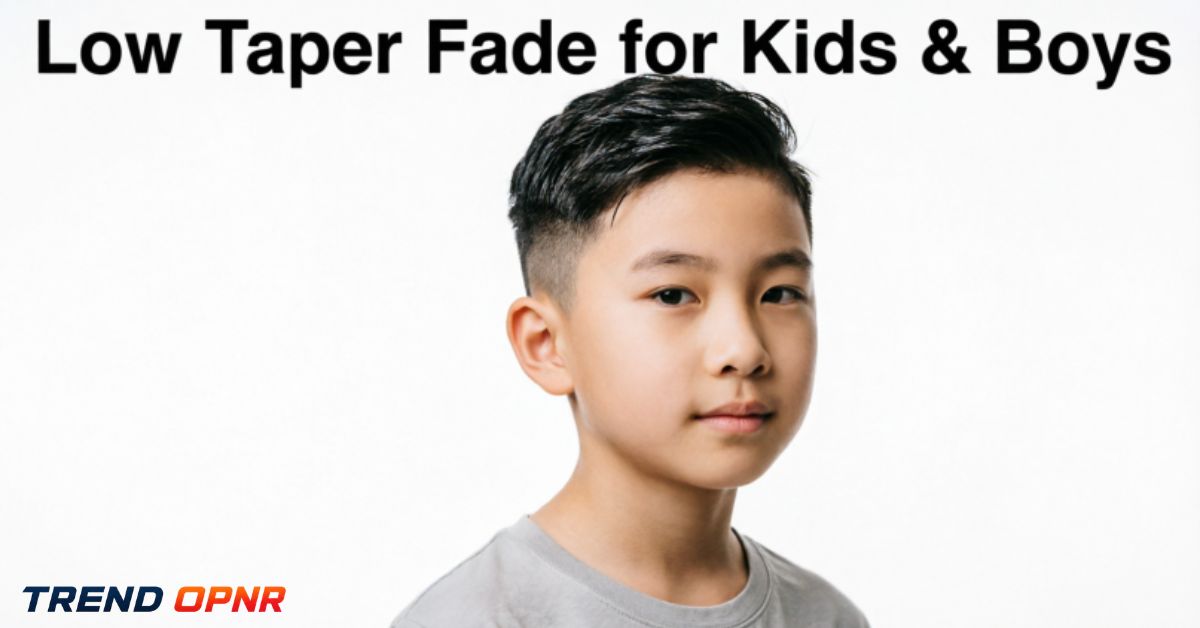

A Low Taper Fade for Kids & Boys keeps the shortest area close to the ears, temples, sideburns, and neckline while preserving useful length through the sides and top. That combination makes the cut adaptable to straight hair, wavy hair, curly hair, coily hair, and Afro-textured hair.
For parents, the appeal is practical: a gradual fade transition can look tidy at school without requiring the aggressive contrast associated with some higher fades. For children, the same haircut can support a textured crop, curly top, comb over, crew cut, natural top, or other haircut style.
This guide covers age, hair type, face shape, school rules, barber communication, maintenance, first-haircut preparation, products, equipment, pricing, and 20+ haircut ideas. The goal is not simply to follow haircut trends, but to choose a modern haircut that suits the child, the school, and the family’s maintenance routine.
What is a low taper fade for kids, and at what age can boys get one?
A Low Taper Fade for Kids & Boys can be considered once a child can comfortably tolerate the tools, sounds, and sitting time required for the haircut. There is no universal minimum age. Babies and very young toddlers often do better with a soft scissor trim, while older toddlers and school-age boys may be ready for a taper haircut.
A barber should consider the child’s scalp sensitivity, hair density, hair texture, hair length, and comfort before selecting a guard size. A first haircut should prioritize child comfort over achieving an especially tight faded base.
KEY POINTS:
- Babies may be better candidates for a scissor-only trim.
- Toddlers generally benefit from a conservative low taper and a larger guard.
- School-age boys can usually choose from more haircut styles.
- A gradual transition is easier to keep school-friendly.
- Children with sensitive scalp or clipper irritation should discuss guard selection with the barber.
- Natural hairlines should not be aggressively altered simply to create a sharper silhouette.
- A rounded neckline can look softer on younger children.
- A squared neckline may suit an older boy who wants a cleaner outline.
- A photo reference helps the barber understand the desired haircut style.
- Hair growth rate determines how quickly the fade needs maintenance.
What Is a Low Taper Fade for Kids & Boys?
A Low Taper Fade for Kids & Boys is a taper fade where the fade transition remains low around the ears and nape instead of climbing high toward the parietal ridge. The top zone keeps more hair length, allowing parents and children to choose between natural styling and more structured hair styling.
The important distinction is the position of the transition zone. A barber controls the blend point, guard progression, and clipper length so the faded base does not overwhelm the child’s natural hair shape.
How Does a Low Taper Fade Actually Work?
The barber normally thinks about the haircut in several connected areas.
The top zone contains the greatest hair length. It may become a textured crop, curly top, comb over, pompadour, buzz cut, French crop, quiff, or natural top.
The transition zone connects the longer top to the shorter sides. Fade blending, clipper blending, freehand blending, or scissors-over-comb can be used according to hair texture and density.
The faded base surrounds the lower sides, temples, sideburns, ears, and nape. The barber uses hair clippers, a fade comb, a trimmer, and different clipper guards to control the fade line.
A good fade transition should look connected rather than striped. The barber works around the occipital bone and parietal ridge while respecting the natural hairline, crown, and head shape.
What Is the Difference Between a Taper and a Fade?
| Feature | Taper | Fade |
| Hair length | Retains more visible hair | Can become extremely short |
| Finish | Softer and more conservative | Higher contrast |
| Best for | Younger children and school settings | Older boys and teens |
| Maintenance | Usually less frequent | Usually more frequent |
| Skin exposure | Usually limited | May reach skin |
| Visual effect | Natural | Stronger gradient |
A taper fade is therefore a broad category, while a low taper, mid taper fade, high taper fade, and skin fade describe different placements and finishes.
For a younger child, a conservative taper haircut often provides enough polish without removing too much hair. A fade haircut can be adjusted by changing the minimum guard size and the height of the fade.
What Makes the Low Taper Fade Different from Mid and High Fades?
A low taper fade keeps the fade transition near the lower side of the head. A mid taper fade rises toward the middle of the side, while a high taper fade approaches the upper side and parietal ridge.
A skin fade goes substantially shorter and can expose skin. That can produce an extreme contrast that is unsuitable for some children or school policies.
For boys under 10, a low taper is generally the more conservative starting point. For older boys, a mid taper fade may provide additional definition. A high taper fade can become a stronger fashion statement, particularly for teenagers.
Why Is the Low Taper Fade So Popular for Boys Right Now?
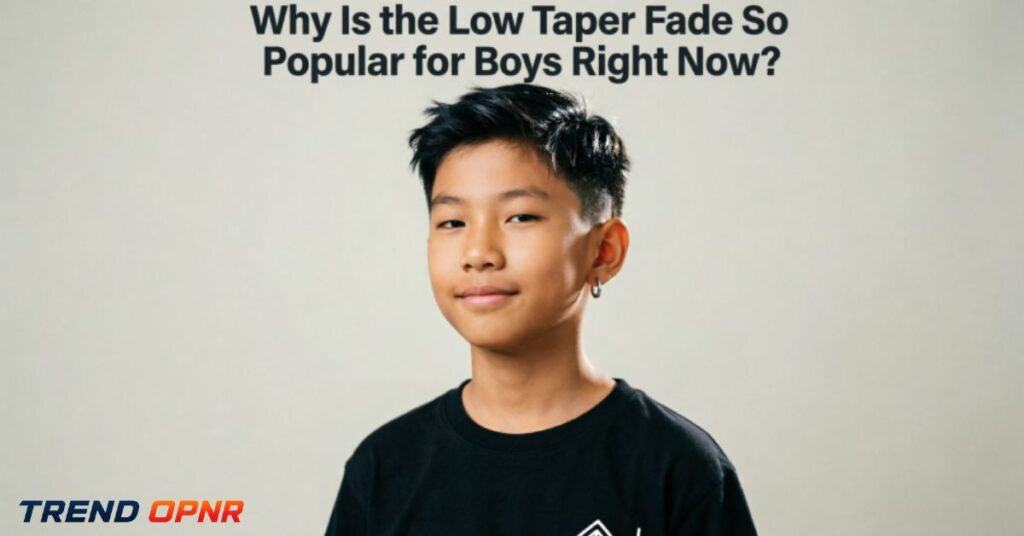
The Low Taper Fade for Kids & Boys fits the current preference for haircuts that look modern without requiring an elaborate daily routine. The style also sits comfortably between a classic haircut and a contemporary fade haircut.
The TikTok Effect: How a Viral Meme Made Every Kid Want This Haircut
The low taper became closely associated with TikTok trends, Gen Alpha boys, and viral meme culture. Ericdoa and Ninja became part of the online conversation surrounding the phrase, helping turn the haircut into a recognizable internet-era reference.
That cultural association matters because children increasingly arrive at a barbershop with a haircut request they have seen through social media, streaming, or a viral meme. Parents do not need to follow every trend, but understanding the reference can make barber communication easier.
The best approach is to separate the meme from the actual haircut. A child may want the name because it is popular, while the barber still needs to decide on the guard size, fade height, top length, neckline, and haircut style.
Why Parents Love This Haircut Too
A Low Taper Fade for Kids & Boys can be practical because the lower taper is relatively subtle. It can work with school, sports practice, recess, outdoor activities, family photos, birthdays, weddings, and everyday wear.
It also adapts well to different hair textures. Straight hair can support a comb over or side part. Wavy hair can become a textured crop. Curly hair can retain natural curls. Coily and Afro-textured hair can support an afro top or 360 waves.
Parents should still remember that a fade is not automatically low-maintenance. A sharp shape-up, clean neckline, or highly defined fade may require frequent barber visits even when the top is easy to manage.
What Are the Best Low Taper Fade Styles for Kids & Boys in 2026?
The following 20+ options expand the usual shortlist and cover different ages, hair textures, lifestyles, and styling preferences. Each Low Taper Fade for Kids & Boys can be customized by changing the top zone, guard progression, blend point, and neckline.
1. Low Taper Fade with Textured Crop
A textured crop is a strong choice for school-age boys because moderate hair length creates movement without requiring complicated hair styling. Point cutting can reduce bulk while preserving the natural shape.
For straight, wavy, thick, or fine hair, the barber can adjust the amount of texture. A small amount of matte clay, matte paste, or texturizing spray can emphasize the haircut style.
Barber brief: “Keep the low taper low, leave enough length on top for texture, point cut lightly, and keep the blend gradual.”
2. Low Taper Fade with Curly Top
A curly top lets natural curls remain the main feature while the lower sides and neckline receive controlled hair tapering. The barber should avoid destroying the curl pattern with excessive thinning.
A curl cream, alcohol-free curl cream, leave-in conditioner, or leave-in conditioner spray can help with curl definition. A curl refresh routine can also restore shape between washes.
Best for: curly hair, natural curls, tight curls, and Afro-textured hair.
3. Low Taper Fade with Comb Over
The comb over provides a classic haircut option for straight hair and fine-textured hair. A low taper keeps the sides tidy while the top remains long enough to create a clear direction.
A light pomade or water-based pomade can provide control without making the hair appear excessively stiff.
Best for: school photos, formal school events, family weddings, and everyday school.
4. Low Taper Fade with Pompadour
The pompadour needs more top length and volume than many children’s cuts. It works particularly well for thick hair and older boys who enjoy hair styling.
A matte paste gives a less formal finish, while a light pomade can create a more polished appearance. Parents should expect a greater styling commitment.
5. Low Taper Fade with Buzz Cut
A buzz cut offers simple hair grooming for active children. A Number 3 guard or Number 4 guard on top keeps enough length for a softer appearance while reducing daily maintenance.
This haircut can work particularly well for summer, sports practice, outdoor activities, and children who dislike long styling sessions.
6. Low Taper Fade with French Crop
A French crop combines a short fringe with textured length through the top. A blunt crop fringe can create a distinctive outline, while point cutting prevents the top from looking overly heavy.
It is a useful school-safe haircut when the fringe and top remain moderate rather than exaggerated.
7. Low Taper Fade with Mohawk / Faux Hawk
A faux hawk provides some personality without requiring a completely shaved side. The barber can leave a wider central strip and use a soft blend around it.
For younger boys, keeping the top moderate makes this haircut style easier to manage and more likely to remain within school grooming rules.
8. Low Taper Fade with Side Part
A side part can be either a soft part or a hard part. A hard part creates a stronger line, so parents should check the student handbook before requesting a shaved design.
For a conservative haircut, ask for a natural side part and a soft blend rather than a razor-defined line.
9. Low Taper Fade with Afro Top (for Black Kids)
Black boys with natural hair can use an afro top to preserve natural texture while controlling the lower sides. Freehand blending can be especially useful where tightly coiled hair does not behave like straight hair.
A curl sponge, defining cream, curl cream, leave-in conditioner, and gentle haircare routine can support natural texture.
The hairline shape-up should be conservative, particularly for younger children. The goal is to clean the natural hairline rather than redraw it dramatically.
10. Low Taper Fade with Broccoli Cut
The broccoli cut pairs rounded volume and natural curls with shorter sides. It is particularly suitable for boys aged 4–10 with curly hair or wavy hair.
The crown should retain enough hair volume to preserve the rounded silhouette. Curl cream and gentle drying can enhance the natural pattern.
11. Low Taper Fade with Crew Cut
The crew cut is a classic haircut with practical advantages. It keeps the top controlled and is easy to wash, dry, brush, and maintain.
A Number 3 guard on top can create a short appearance, while a slightly longer top gives the barber more room for a gradual fade transition.
12. Low Taper Fade with Slicked-Back Top
A slicked-back top suits older boys and teenagers who want a formal appearance for weddings, holidays, family photos, or other events.
The barber should leave enough hair length to move the hair backward without forcing it. A light pomade or water-based styling product can provide control.
13. Low Taper Fade with Spiky Top
A spiky top is playful and can work for younger boys who want a visibly styled haircut. About two inches of top length may be sufficient, depending on hair density.
Use a small amount of light wax or water-based gel rather than a heavy adult-strength product.
14. Low Taper Fade with Modern Mullet
The modern mullet combines shorter sides with extra length toward the back. It can be an expressive choice for tweens and teens, but it should always be checked against school rules.
The barber should preserve the relationship between the top zone, crown, neckline, and longer back section so the silhouette remains intentional.
15. Low Taper Fade with 360 Waves (for Black Boys)
360 waves require commitment rather than simply a haircut. A wave brush, durag, appropriate moisturizing product, and consistent wave training are part of the process.
The barber can maintain a low taper while keeping the top flat enough for wave training. A shape-up can refresh the hairline without unnecessarily changing the natural structure.
16. Low Taper Fade with Quiff
A quiff adds controlled height without requiring the full volume of a pompadour. It works well with straight or wavy hair and can be adapted for school.
A lightweight mousse, matte paste, or small amount of texture powder can create volume without excessive weight.
17. Low Taper Fade with Flat Top
A flat top creates a strong horizontal silhouette and works particularly well with dense, coily, or Afro-textured hair.
The barber should consider the child’s face geometry and natural hair volume before choosing the height. This is more distinctive than a basic school haircut.
18. Low Taper Fade with Natural Top
For parents who want minimal styling, keep the top natural and focus on a clean fade transition around the ears and neckline.
This is one of the easiest choices for daily maintenance because the haircut works with the child’s existing hair pattern rather than fighting it.
19. Low Taper Fade with Curly Crop
A curly crop keeps curls shorter than a full curly top while preserving visible curl definition. It is useful for boys who want natural texture without significant hair volume.
A defining cream or curl cream can enhance the pattern, while a wide-tooth comb can help with gentle detangling.
20. Low Taper Fade with Textured Fringe
A textured fringe places controlled movement toward the forehead. It can suit straight hair, wavy hair, and some curly hair patterns.
The barber can use point cutting rather than creating an overly blunt edge, helping the fringe blend with the top.
21. Low Taper Fade with Blunt Crop Fringe
A blunt crop fringe gives a stronger graphic shape than a textured fringe. For school, keeping the fringe moderate is usually safer than creating an extreme contrast.
The rest of the haircut can remain conservative with a gradual low taper and natural neckline.
22. Low Taper Fade with Wave Haircut
A wave haircut can use a longer top to preserve the wave pattern. A low taper cleans the lower perimeter while allowing the natural pattern to remain visible.
Wave maintenance should focus on gentle brushing, moisture, and avoiding excessive product buildup.
23. Low Taper Fade with Afro Haircut
An afro haircut celebrates natural volume. The barber can shape the afro while keeping a soft taper around the ears, temples, and nape.
For dense natural hair, the blend point should be controlled carefully so the haircut retains balanced proportions.
24. Low Taper Fade with Faux Hawk and Textured Top
This variation combines a central lift with a school-friendly perimeter. It can be a useful compromise for a child who wants an edgy style without a full high fade.
Matte clay or lightweight mousse can provide hold while retaining natural movement.
Which Low Taper Fade Works Best for Your Child’s Hair Type?
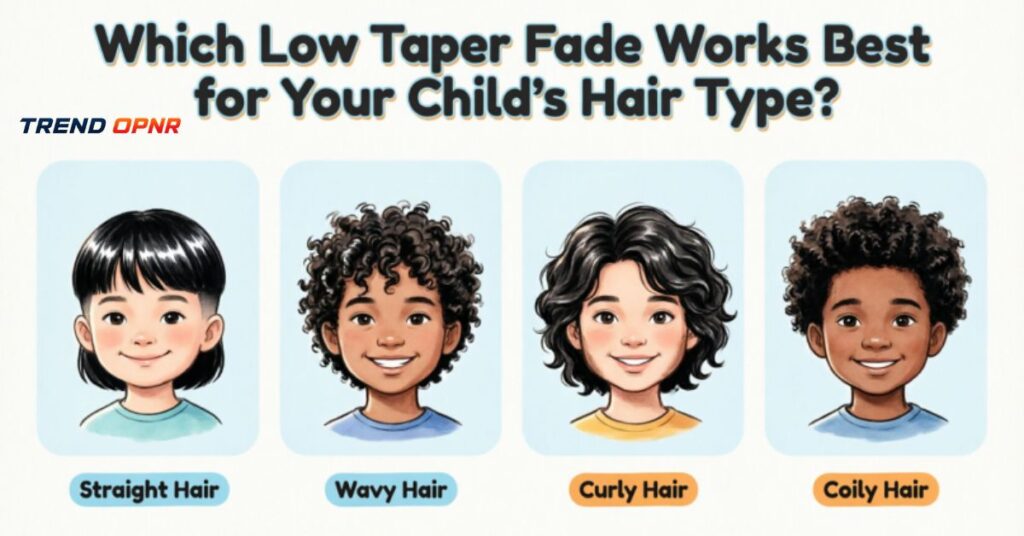
The best Low Taper Fade for Kids & Boys depends heavily on hair texture, hair density, hair volume, curl pattern, wave pattern, and natural hairline. The same guard progression can look completely different on fine straight hair and dense coily hair.
Low Taper Fade for Curly Hair Boys
Curly hair benefits from a barber who understands how shrinkage changes apparent hair length. The top should generally be judged in its natural curl state rather than only when stretched.
Best styles: curly top, curly crop, broccoli cut, textured fringe.
Useful products: curl cream, alcohol-free curl cream, leave-in conditioner, defining cream.
Technique: freehand blending and careful scissors-over-comb can protect the natural curl pattern.
Low Taper Fade for Straight Hair Boys
Straight hair makes fade lines and uneven blending easier to see, so the barber should pay close attention to the transition zone and blend point.
Best styles: comb over, side part, textured crop, slicked-back top.
Useful products: light pomade, water-based pomade, water-based gel, matte paste.
Technique: scissors-over-comb and controlled clipper blending can produce a clean silhouette.
Low Taper Fade for Wavy Hair Boys
Wavy hair is highly adaptable because it can support both structured and natural haircut styles. Leaving moderate length on top gives the wave pattern enough room to form.
A sea salt spray, texturizing spray, or lightweight mousse can emphasize movement without making the hair heavy.
Low Taper Fade for Thick Hair Boys
Thick hair benefits from controlled removal of bulk. Point cutting can reduce weight while preserving useful length through the top.
A barber may use several guard sizes during clipper blending and then refine the top with barber scissors. Matte clay or texture powder can control excess volume.
Low Taper Fade for Fine Hair Boys
Fine hair usually benefits from a less aggressive minimum guard size. A Number 3 guard or Number 4 guard can maintain the appearance of density.
Avoid over-thinning the top. A textured crop, French crop, or natural top can create the impression of more volume without relying on heavy hair product.
Low Taper Fade for Black Kids (Afro / 4C Hair)
For Black kids, natural hair, Afro-textured hair, coily hair, and 4C hair require techniques that respect the curl structure. Freehand blending can be useful around tightly coiled areas where conventional clipper blending may remove too much visual density.
The barber should understand natural hairlines, curl definition, hair density, and the difference between creating a clean shape-up and artificially changing the hairline.
Useful products include curl sponge, wave sponge, defining cream, curl cream, leave-in conditioner, and gentle sulfate-free shampoo.
Low taper fade for 10 year old boy
A Low Taper Fade for Kids & Boys is a practical choice for a 10-year-old who wants a current haircut without an overly dramatic fade. A textured crop, crew cut, comb over, curly crop, or natural top can all work well at this age.
For school, parents should favor a soft blend, moderate top length, and no shaved designs unless the school policy clearly allows them. A photo reference should show the exact shape rather than simply saying “fade.”
A 10-year-old can usually participate in the haircut consultation. Letting him choose between two or three suitable styles can improve cooperation and make the haircut feel personal rather than imposed.
Low taper fade for kids & boys short hair
Short hair pairs naturally with a Low Taper Fade for Kids & Boys because the lower perimeter stays clean while the top remains easy to manage. Buzz cuts, crew cuts, short textured crops, and short natural tops are particularly practical.
A Number 3 guard or Number 4 guard can provide a conservative starting point when parents want visible hair rather than skin exposure. The barber can use a gradual transition instead of an abrupt fade line.
For sports and summer, short hair reduces styling time. For school picture day, a small amount of matte paste or light pomade can add definition without making the haircut look overly formal.
Low taper fade for kids & boys straight hair
A Low Taper Fade for Kids & Boys works particularly well with straight hair because the fade transition is easy to see and the top can be shaped into a comb over, side part, quiff, textured crop, or slicked-back top.
Straight hair can also reveal regrowth quickly, especially when the faded base is very short. Parents who prefer less frequent barber visits should request a softer taper rather than an extremely tight finish.
A barber may use scissors-over-comb through the top and clipper blending around the lower sides. The final haircut should follow the natural hairline instead of forcing an artificial shape.
Low taper fade for kids & boys black
For Black boys, a Low Taper Fade for Kids & Boys can frame natural hair beautifully while leaving room for an afro top, curly crop, 360 waves, flat top, or natural curls. The most important factor is finding a barber experienced with Afro-textured hair.
Freehand blending can protect the natural texture, while a careful hairline shape-up can make the perimeter appear neat. The barber should not automatically copy techniques designed for straight hair.
Parents should prioritize moisture, gentle detangling, scalp care, and a suitable haircare routine. A satin pillowcase, silk pillowcase, leave-in conditioner, and curl cream can help reduce friction and preserve definition.
Read More: Mid Taper Fade for Curly Hair: 15 Best Styles for Men (2026)
Low taper fade for kids & boys long hair
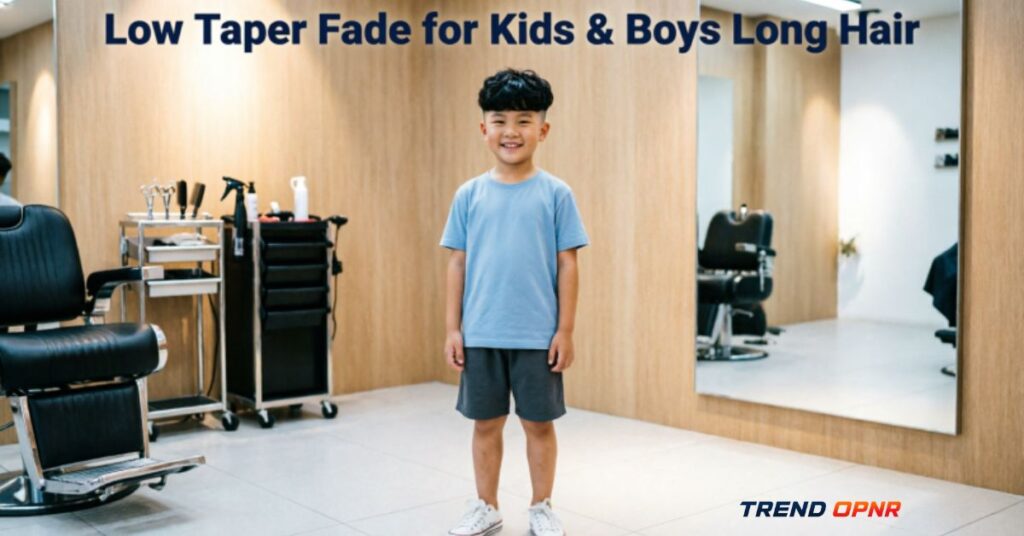
A Low Taper Fade for Kids & Boys does not require a very short top. Long hair can remain through the crown and top while the barber tapers only the lower perimeter.
This option works for children who want to preserve hair movement. A longer textured top, curly top, quiff, modern mullet, or slicked-back top can provide personality without raising the fade.
Parents should clarify exactly how much hair length they want removed. “Keep the top long” is less useful than a measurable request such as “leave 3–4 inches on top,” when that length suits the child’s hair.
Little Boy Low Taper fade
A Low Taper Fade for Kids & Boys can be adapted for little boys by keeping the process simple and the minimum guard conservative. Ages 5–7 are often a good time to introduce more haircut style choices because children can communicate preferences more clearly.
Textured crop, French crop, comb over, spiky top, and natural top are practical options. Avoid unnecessarily long appointments, elaborate designs, or complicated styling routines.
The haircut should remain age-appropriate. A soft taper with a natural neckline can look cleaner as it grows out than an extremely tight fade.
What Is the Best Low Taper Fade for Each Age Group?
Age should influence the guard selection, styling demands, appointment length, and haircut complexity. A Low Taper Fade for Kids & Boys can look very different on a toddler, school-age boy, tween, or teenager.
Baby Taper Fade: Is It Appropriate for Babies Under 2?
For babies and children under 2, a scissor-only trim is often the gentler approach when a haircut is actually needed. A toddler scalp and young children’s scalp can be sensitive, and a first-time haircut should not become a stressful event simply to achieve a fashionable fade.
Parents can request a soft scissor trim around the ears, sides, and neckline. If clippers are being considered, discuss the child’s scalp sensitivity and comfort with an experienced barber.
Toddler Taper Fade (Ages 2–5): What Works Best?
Toddlers generally benefit from simplicity. A Number 3 guard or Number 4 guard can leave more hair between the scalp and blade than an aggressive fade.
A toddler haircut can feature a buzz cut, natural top, textured crop, or simple low taper. Avoid complicated hard parts, sharp designs, and long appointments when the child is uncomfortable.
Little Boy Taper Fade (Ages 5–7) Playful But Neat
At this stage, boys can start expressing haircut preferences. Parents can offer several choices rather than asking an open-ended question.
A soft taper, textured crop, comb over, French crop, or spiky top can provide personality while remaining practical for school and everyday wear.
School-Age Boys Taper Fade (Ages 8–12) The Core Audience
School-age boys often want a modern haircut influenced by friends, TikTok, social media, and trending boys’ hairstyles. Parents usually need to balance that interest with the school grooming policy.
A low taper remains a versatile option because the top can change without changing the basic perimeter. A textured crop can become a comb over later, while a natural top can eventually become a quiff.
Teen Taper Fade (Ages 13–17) Style-Driven Choices
Teenagers typically have stronger preferences and can manage more complicated hair styling. A low taper, mid taper fade, high taper fade, or even skin fade may fit depending on personal preference and school rules.
Teens may also explore 360 waves, modern mullet, pompadour, faux hawk, hard part, or more distinctive haircut trends. The teenager should still understand that a school dress code may limit designs or skin exposure.
Quick Age Reference Guide
| Age Group | Practical Starting Point | Top Style | Typical Maintenance |
| Children under 2 | Scissor-only trim | Natural top | 6–8 weeks |
| Boys aged 2–5 | Low taper | Buzz, natural top, crop | 5–6 weeks |
| Boys aged 5–7 | Low taper | Crop, comb over, spiky top | 4–5 weeks |
| Boys aged 8–12 | Low or mid taper | Most school-safe styles | 3–4 weeks |
| Boys aged 10–16 | Low, mid, or selected high taper | Style based on preference | 2–4 weeks |
| Boys aged 13–17 | Any appropriate fade | Teen-focused styles | 2–3 weeks |
Which Low Taper Fade Suits Your Child’s Face Shape?
Face shape is useful, but it should not override hair texture, comfort, or the child’s preferences. A Low Taper Fade for Kids & Boys can be adapted to round, oval, square, or heart-shaped facial structure.
Low Taper Fade for Round Faces
A round face can benefit from volume on top because additional height can visually lengthen the face. A quiff, pompadour, or textured crop can provide that effect.
Low Taper Fade for Oval Faces
An oval face generally provides balanced proportions, making it compatible with many haircut styles. Parents can focus on hair texture, lifestyle, and personal preference.
Low Taper Fade for Square Faces
A square face has a stronger jawline, so a soft blend can prevent the overall silhouette from appearing excessively rigid. A textured crop or comb over can balance the facial structure.
Low Taper Fade for Heart-Shaped Faces
A heart-shaped face often has a wider forehead and narrower chin. A French crop, broccoli cut, or controlled natural top can help create balanced proportions without aggressively removing the sides.
| Face Shape | Good Pairing | Main Consideration |
| Round face | Pompadour, quiff, textured crop | Add controlled height on top |
| Oval face | Most styles | Preserve natural balance |
| Square face | Textured crop, comb over | Prefer a soft blend |
| Heart-shaped face | French crop, broccoli cut | Avoid excessive upper-side removal |
How Do You Tell the Barber What Low Taper Fade You Want?
The safest barber communication combines the haircut name, fade placement, minimum guard, top length, neckline preference, and school requirement. A reference photo makes the request easier to interpret.
Instead of saying “give him a fade,” describe the actual haircut. For example: “Start the taper just above the ear, blend gradually, keep the top natural, use a Number 3 guard minimum, and keep the finish school-safe.”
The Complete Parents’ Barber Scripts
Script 1 — Conservative young-boy taper:
“I want a low taper fade starting just above the ear. Keep the transition gradual, leave the top natural, and use a Number 3 guard minimum. Please keep the neckline soft and school-safe.”
Script 2 — Textured crop:
“Please keep the fade low and gradual. Leave about 2 inches on top, use point cutting for texture, and keep the fringe moderate. I want a soft blend rather than a sharp contrast.”
Script 3 — Curly hair:
“Please keep the curls natural on top. Shape the curl pattern without taking away unnecessary length, and use freehand blending around the sides.”
Script 4 — Black boys and natural hair:
“Keep the natural texture on top, shape the afro or curls, use a conservative taper around the ears and nape, and clean the natural hairline without changing its shape too aggressively.”
Script 5 — School-safe request:
“Please keep the taper low, avoid skin showing, avoid shaved designs, use a gradual blend, and leave moderate length on top.”
Script 6 — Straight hair:
“Keep the sides low and blended, leave enough length for a comb over, and use scissors-over-comb on top.”
Script 7 — Long top:
“Keep the top long and natural, taper only the lower sides and neckline, and preserve the crown and overall hair shape.”
Script 8 — Fine hair:
“Please use a Number 3 or Number 4 guard minimum and avoid over-thinning the top. I want the hair to keep its visual density.”
Script 9 — Thick hair:
“Remove excess bulk through point cutting while keeping the top long enough for texture. Blend the sides gradually.”
Essential Questions to Ask the Barber Before the Cut
- Are you experienced with children’s haircuts?
- Have you worked with this hair texture before?
- What guard size will you use?
- Where will the blend point sit?
- Will you use freehand blending, clipper blending, or scissors-over-comb?
- How much hair length will remain on top?
- Will you preserve the natural hairline?
- What neckline would you recommend?
- Can you show examples of similar boys’ haircut styles?
- Do you have vibration-reduced clippers?
- How long should the barber appointment take?
- What maintenance schedule do you recommend?
What NOT to Say at the Barbershop
Avoid vague instructions such as “just make it cool,” “just a fade,” or “take a little off.” These descriptions leave too much room for interpretation.
Instead, specify the low taper, guard selection, top length, blend point, neckline strategy, and haircut preferences. A photo reference is useful, but it should be accompanied by verbal instructions.
How Do You Maintain a Low Taper Fade for Kids at Home?
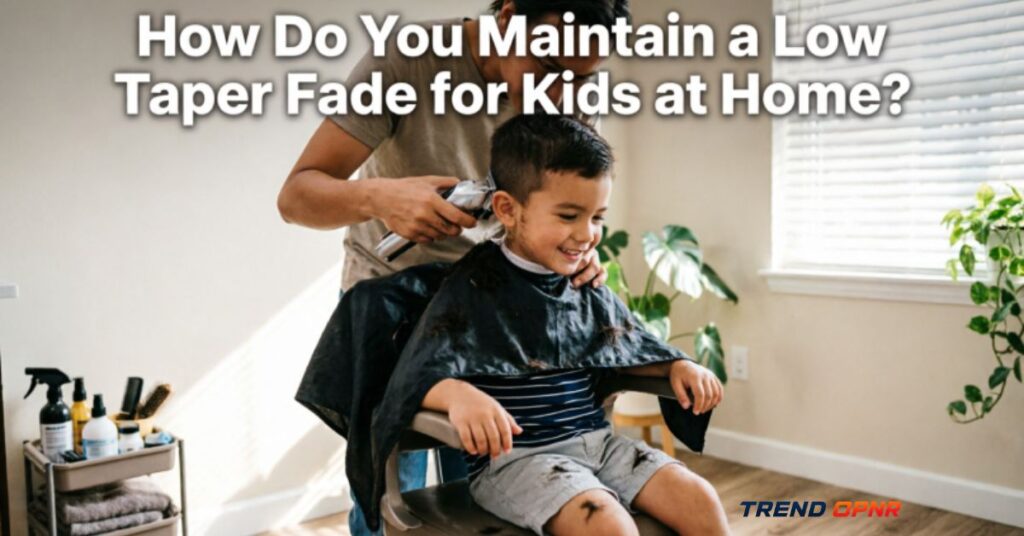
A Low Taper Fade for Kids & Boys stays presentable longer when the top and scalp receive appropriate care. The maintenance routine should be based on hair texture, density, product use, washing frequency, and the child’s activity level.
The Complete Weekly Home Maintenance Routine
| Step | Routine | Suitable Tool/Product |
| 1 | Brush or shape hair gently | Soft-bristle brush |
| 2 | Wash as needed | Gentle shampoo |
| 3 | Condition when appropriate | Conditioner or leave-in |
| 4 | Apply a small amount of product | Hair product matched to texture |
| 5 | Detangle curls carefully | Wide-tooth comb |
| 6 | Protect hair overnight | Satin pillowcase or silk pillowcase |
| 7 | Inspect neckline and shape | Handheld mirror |
| 8 | Book professional maintenance | Barber appointment |
Daily brushing can help straight and wavy hair, while curly and coily hair often benefit more from gentle detangling and moisture management. Hair hydration is especially important for natural curls.
How to Do a Quick At-Home Touch-Up Between Barber Visits
Parents can handle basic grooming but should be cautious about attempting professional fade blending. A trimmer may be appropriate for obvious neckline cleanup if the parent is confident, but changing the transition zone can easily create a visible fade line.
Useful equipment includes hair clippers, clippers with guard attachments, a trimmer, fade comb, handheld mirror, and appropriate clipper guards.
The safest principle is to avoid cutting shorter than the original professional guard progression unless the barber has specifically instructed you.
How to Keep Curly Hair Looking Fresh Between Trims
Curly hair can benefit from a leave-in conditioner spray, curl cream, defining cream, curl sponge, or other lightweight product suited to the curl pattern.
Avoid excessive manipulation. A wide-tooth detangling comb can help with detangling, while a satin pillowcase or silk pillowcase can reduce hair friction overnight.
For Black boys with natural hair, a wave brush may support wave maintenance, while a durag can help preserve trained waves. Product selection should remain gentle and age-appropriate.
Signs It Is Time for a Barber Visit
- The fade transition no longer looks intentional.
- The neckline has become uneven or overgrown.
- The sideburns have lost their shape.
- The top no longer holds its haircut style.
- The hair feels too bulky around the ears.
- School picture day is approaching.
- The child wants a different haircut style.
- Regrowth has changed the original silhouette.
- The hairline needs professional cleanup.
- The current shape no longer matches the child’s preferences.
How Much Does a Kid’s Low Taper Fade Haircut Cost?
The Low Taper Fade for Kids & Boys can vary substantially in price depending on country, city, barber experience, barbershop type, appointment length, and whether the service includes styling or a specialized children’s experience.
For U.S. reference points, a basic service may fall around 15–25, a specialty kids’ service around 25–40, and a premium service around 40–60. Mobile services can be higher. These are illustrative ranges rather than universal current prices.
Kids Taper Fade Price Breakdown
| Service | Typical U.S. Reference Range | Possible Value |
| Neighborhood barbershop | 15–25 | Basic haircut |
| Kids’ salon | 25–40 | Child-focused experience |
| Premium barbershop | 40–60 | Consultation and styling |
| Mobile barber | 50–80 | Home convenience |
| Chain salon | 18–28 | Standard service |
Smart Ways to Save Money on Kids’ Taper Fades
- Ask whether the barbershop offers sibling discounts.
- Check for loyalty programs.
- Consider off-peak appointments.
- Avoid unnecessary premium add-ons.
- Extend the trim schedule when the haircut still looks good.
- Maintain the top properly at home.
- Ask whether a softer taper can reduce visit frequency.
- Book multiple children together if the barber offers a family rate.
Is a Low Taper Fade Haircut School-Appropriate for Boys?
In many school environments, a conservative Low Taper Fade for Kids & Boys is more likely to fit the grooming policy than a skin fade, extreme high fade, or heavily designed haircut. However, schools vary, so the student handbook should always be the final authority.
What Most School Dress Codes Say About Fade Haircuts
The safest principle is moderation. A gradual taper with no skin showing, no bold patterns, and moderate top length is generally less likely to attract concerns than an extreme contrast.
Policies may address shaved designs, hair designs, extreme hair length, sharp lineups, or other grooming features. Some schools are much stricter than others.
The Safest Low Taper Fade Choices for Strict Schools
- Textured crop
- Comb over
- French crop
- Crew cut
- Natural top
- Soft scissor fade
- Conservative taper
- Moderate curly crop
School-Safe Fade Checklist for Parents
- Check the school dress code.
- Read the student handbook.
- Avoid skin showing if the rules are unclear.
- Avoid shaved designs.
- Avoid bold patterns.
- Keep moderate hair length.
- Request a soft blend.
- Consider a natural neckline.
- Avoid an extreme contrast.
- Ask the barber to keep the fade low.
How Do You Prepare Your Child for Their First Taper Fade Haircut?
A Low Taper Fade for Kids & Boys should never be more important than the child’s comfort during a first barbershop visit. Preparation can make the experience calmer, particularly for toddlers or children who are nervous around hair clippers.
Step-by-Step First Barbershop Visit Preparation
Step 1: Explain the haircut.
Use simple language. Explain that the clippers make a buzzing sound and that the barber will work around the ears and back.
Step 2: Watch age-appropriate barber videos.
Short videos on YouTube or TikTok can familiarize children with the chair, cape, clippers, and handheld mirror.
Step 3: Choose an experienced barber.
Look for a kid-friendly barber who regularly works with young children.
Step 4: Schedule a quiet appointment.
Off-peak appointments can reduce noise, waiting, and crowd-related stress.
Step 5: Bring a comfort item.
A favorite toy, book, headphones, or familiar object can make the barber chair feel less intimidating.
Step 6: Bring a reference photo.
Let the child see the picture before the haircut begins.
Step 7: Offer limited choices.
Instead of asking “What haircut do you want?” offer two or three parent-approved options.
Step 8: Plan breaks when necessary.
A short pause can be better than forcing a child to sit through discomfort.
Step 9: Celebrate completion.
Keep the first experience positive rather than focusing on perfection.
Low Taper Fade for Kids with Sensory Sensitivity
Children who dislike buzzing sounds, vibrations, capes, mirrors, touch around the ears, or long appointments may need additional preparation. Parents can tell the barber about specific sensitivities before the appointment.
A kid-friendly barber may offer vibration-reduced clippers, quieter tools, shorter sessions, or breaks. Some children may benefit from starting with scissors and gradually introducing clippers over subsequent visits.
The objective is to make the first haircut experience predictable. A calm appointment is more valuable than completing a particular haircut style at all costs.
What Are the Best Styling Products for a Kids’ Low Taper Fade?
A Low Taper Fade for Kids & Boys rarely needs a large amount of product. The best styling product depends on hair texture, density, age, scalp sensitivity, and the desired haircut style.
Product Recommendations by Hair Type
| Hair Type | Useful Product | Main Goal |
| Straight | Light pomade, water-based gel | Control |
| Fine | Texturizing spray, lightweight mousse | Volume |
| Wavy | Sea salt spray, lightweight mousse | Movement |
| Curly | Curl cream, leave-in conditioner | Definition |
| Thick | Matte clay, matte paste | Bulk control |
| Coily/4C | Defining cream, curl cream | Moisture and definition |
| Afro | Curl sponge, defining cream | Shape |
| Waves | Wave brush, suitable wave product | Pattern maintenance |
Products to Always Avoid for Kids’ Hair
Parents should be cautious with heavy products, excessive fragrance, harsh ingredients, and formulations that irritate the child’s scalp.
Alcohol-free products can be preferable for dry or curly hair, while sulfate-free shampoo can be useful for families who want a gentler washing routine. Baby-safe shampoo and gentle shampoo may be appropriate for younger children, but parents should choose products based on the child’s individual needs.
Do not assume that a product marketed for adults is automatically suitable for a child.
What Are the Best Father-Son Matching Low Taper Fade Ideas?
Matching haircuts do not need to be identical. A father can wear a mid taper fade while a younger son wears a low taper, creating a coordinated appearance without forcing an adult haircut onto a child.
| Dad’s Style | Son’s Matching Style | Occasion |
| Low taper + textured crop | Low taper + French crop | Everyday |
| Mid taper + comb over | Low taper + comb over | Formal events |
| Low taper + pompadour | Low taper + textured crop | Family photos |
| Low taper + 360 waves | Low taper + natural top | Family occasions |
| Low taper + slicked-back top | Low taper + side part | Weddings |
| Low taper + quiff | Low taper + textured crop | Birthdays |
| Low taper + natural top | Low taper + curly top | Casual outings |
The best matching approach preserves age-appropriate hair length and hair styling. A child does not need the same guard progression, top length, or neckline as a parent.
What Is the Best Low Taper Fade for Each Season?
Seasonal haircut planning can make maintenance easier. Summer may favor short, breathable styles, while winter can support a longer top. Back-to-school appointments are often more important for parents who want a fresh school-safe haircut.
| Season | Recommended Style | Why It Works |
| Summer | Low taper + buzz or short crop | Easy for outdoor activities |
| Back to school | Low taper + comb over | Conservative and photo-ready |
| Winter | Low taper + longer top | More length and flexibility |
| Holidays | Low taper + side part | Polished for family events |
| Birthday | Low taper + textured style | Playful and expressive |
| Sports season | Low taper + crew cut | Low daily maintenance |
20+ School-Safe Style Selection Guide
When choosing among Low Taper Fade for Kids & Boys options, parents can use a simple decision framework:
- Choose the school requirement first.
- Identify the child’s hair texture.
- Check hair density.
- Consider face shape.
- Decide the preferred top length.
- Choose a conservative guard size.
- Decide between a natural or defined neckline.
- Determine how often the family wants barber visits.
- Consider sports and outdoor activities.
- Consider the child’s willingness to style the top.
- Decide whether a product is actually necessary.
- Bring a photo reference.
- Explain the preferred blend point.
- Ask about clipper sensitivity.
- Confirm the minimum guard.
- Check whether the barber has experience with the child’s texture.
- Confirm the haircut cost.
- Book enough appointment time.
- Plan the first haircut around the child’s comfort.
- Review the finished shape from the front, sides, and back.
- Photograph the finished haircut for future reference.
- Record the guard progression if the result is especially successful.
Haircut Technique: What a Good Barber Should Control
Professional hair tapering is more than running clippers around the sides. The barber needs to understand the relationship between the transition zone, top zone, faded base, hair density, hair texture, head shape, and natural hairline.
The barber may use a #1 guard, #2 guard, #3 guard, #4 guard, Number 1 guard, Number 2 guard, Number 3 guard, or Number 4 guard depending on the child’s age and desired result. Guard progression should be gradual rather than arbitrary.
Hair clippers establish the main lengths, while a trimmer can refine the lower perimeter. A fade comb helps control hair during clipper blending. Barber scissors support scissors-over-comb and point cutting.
Freehand blending can be particularly valuable for coily or Afro-textured hair. The barber may also work around the occipital bone, parietal ridge, crown, temples, sideburns, ears, and nape to preserve the head’s natural structure.
How Guard Size Changes the Result
Guard size determines how much hair remains beneath the blade. A larger guard generally leaves more hair, while a smaller guard creates a shorter finish.
For toddlers, parents may prefer a Number 3 guard or Number 4 guard minimum. Fine hair can also benefit from a larger minimum guard because excessive shortening may make the sides appear sparse.
A professional barber should select guard attachments according to hair density, hair texture, scalp sensitivity, and the desired fade transition. Guard selection should not be based solely on what another child has.
Hairline, Neckline, and Shape-Up Tips
The hairline is part of the haircut silhouette. A sharp shape-up can create a crisp appearance, but it can also make a young child’s hairline look less natural if too much is removed.
A rounded neckline tends to look softer, while a squared neckline creates a more structured finish. The nape should remain clean without unnecessarily exposing large areas of skin.
Sideburns and temples should connect naturally to the rest of the taper. The barber should check both sides for balance rather than assuming the head is perfectly symmetrical.
Low Taper Fade vs Other Fade Options
| Style | Position | Contrast | Typical Audience |
| Low taper | Near ears and nape | Low | Children, school-age boys |
| Mid taper fade | Middle side | Medium | Older boys, tweens |
| High taper fade | Upper side | High | Teens |
| Low fade | Low side | Medium | Children and adults |
| Skin fade | Very short/skin | Very high | Older boys and teens |
| Classic taper | Lower perimeter | Low | Younger children |
| Scissor fade | Soft scissor transition | Low | Conservative school cuts |
A Low Taper Fade for Kids & Boys is often the middle ground for parents who want something modern without the visual intensity of a skin fade.
Low Taper Fade Maintenance Schedule
Haircut frequency depends on the child’s hair growth rate, hair density, desired sharpness, and school schedule.
A softer taper may remain acceptable for 4–6 weeks. A crisp fade may need attention around 2–4 weeks. A shape-up can sometimes refresh the perimeter without requiring a full haircut.
For children with slower-growing hair or a deliberately natural haircut, a 5–6 week interval may work. For teenagers who want a very defined fade, a 2–3 week trim may be more realistic.
A 3–5 week maintenance cycle is a useful general planning range, but the correct schedule is the one that matches the child’s actual regrowth.
Haircare Routine by Texture
Straight Hair
Use gentle washing, light daily brushing, and modest styling product. A wide-tooth comb can help with longer top sections.
Wavy Hair
Avoid excessive brushing when the hair is dry if it disrupts the wave pattern. Lightweight mousse or sea salt spray can enhance movement.
Curly Hair
Prioritize hair hydration, curl definition, gentle detangling, and limited manipulation. Leave-in conditioner and curl cream can support natural curls.
Coily and 4C Hair
Moisture management, gentle detangling, natural texture preservation, and a skilled barber are especially important. A curl sponge, defining cream, leave-in conditioner, and wave brush can serve different styling purposes.
Fine Hair
Avoid excessive weight from heavy styling products. A lightweight mousse or texturizing spray can create volume while maintaining movement.
Thick Hair
Control bulk through haircut technique rather than relying entirely on styling products. Point cutting can remove weight without making the top excessively short.
Choosing a Kid-Friendly Barber or Barbershop
A successful haircut depends as much on the barber experience as the haircut technique. Parents should look for a barbershop, kids’ salon, specialty kids’ salon, neighborhood barbershop, chain salon, mobile barber, or home-visit barber that suits the child’s age and needs.
When comparing options, review:
- Barber reviews
- Barber experience
- Kids’ barber experience
- Kid-friendly barber availability
- Haircut prices
- Barber appointment length
- Experience with natural hair
- Experience with curly hair
- Experience with toddlers
- Comfort with first haircuts
- Quiet appointment options
- Vibration-reduced clippers
- Sibling discounts
- Loyalty programs
A premium haircut is not necessarily better for every child. For some families, the best value is an experienced barber who can create the desired haircut efficiently and calmly.
Barber Equipment Parents May Hear About
Professional barbering equipment can include:
- Hair clippers
- Clippers
- Trimmer
- Fade comb
- Guard attachments
- Clipper guards
- Barber scissors
- Razor
- Straight razor
- Handheld mirror
- Vibration-reduced clippers
Parents do not need to own every tool. A professional haircut depends on technique, sanitation, guard progression, and the barber’s experience.
How to Make the Haircut More School-Friendly
A school-safe haircut does not have to be boring. A textured crop, curly top, comb over, French crop, crew cut, quiff, natural top, or moderate side part can all look current while remaining conservative.
The safest visual principles are:
- Low taper
- Gradual taper
- No skin showing
- No shaved designs
- No bold patterns
- Moderate top length
- Soft blend
- Natural neckline
- Moderate contrast
- No extreme high fade
If the school rules are unclear, ask the school office before the appointment. A haircut that is technically stylish is not useful if the child has to change it immediately.
Haircut Planning for School Pictures and Events
For school picture day, parents should avoid booking a completely unfamiliar haircut immediately beforehand. A familiar haircut reduces the chance of an unexpected shape.
For weddings and formal events, a comb over, side part, slicked-back top, pompadour, or quiff can add polish. For sports practice, a crew cut, buzz cut, short textured crop, or natural top may be easier.
Family photos often benefit from coordinated grooming rather than identical cuts. The child’s haircut should still look like the child.
First Haircut and First Taper Fade: Parent Tips
The first haircut should be treated as an experience rather than a test. Children can become anxious about the cape, mirror, chair, buzzing noise, water spray, scissors, or unfamiliar adult.
A parent can help by explaining each step, showing a photo, bringing a comfort item, selecting a kid-experienced barber, and allowing breaks.
A first taper fade can be introduced after the child is comfortable with the barbershop environment. There is no benefit in forcing a complicated fade when a soft scissor trim would produce a calmer first experience.
The Best Haircut by Lifestyle
| Lifestyle | Recommended Haircut Style |
| Sports-heavy | Crew cut, buzz cut, short crop |
| Busy school mornings | Natural top, crew cut |
| Formal events | Comb over, side part |
| Curly hair | Curly top, curly crop |
| Black boys | Afro top, 360 waves, curly crop |
| Creative child | Faux hawk, textured fringe |
| Minimal styling | Natural top, buzz cut |
| Fashion-focused teen | Mullet, quiff, pompadour |
| Strict school | Conservative taper, textured crop |
| Long-hair preference | Low taper with long top |
What Makes a Modern Kids’ Haircut Age-Appropriate?
A modern haircut should fit the child rather than simply reproduce an adult style. Guard size, top length, neckline, hairline, styling product, and maintenance should all reflect the child’s age.
For young boys, classic haircut choices often work because they grow out naturally. For tweens and teens, modern haircut trends can be incorporated through texture, volume, or controlled styling rather than extreme skin exposure.
The strongest haircut style is the one the child can comfortably wear at school, during sports, at family events, and at home.
Complete Parent Decision Guide
Before booking a Low Taper Fade for Kids & Boys, ask:
- What does the school grooming policy allow?
- How short should the faded base be?
- Does the child have a sensitive scalp?
- What is the child’s natural hair texture?
- Is the hair fine, thick, dense, or low-density?
- How much top length does the child want?
- Does the child need a low-maintenance haircut?
- How often can the family schedule barber visits?
- Is the barber experienced with children?
- Does the barber understand natural or Afro-textured hair?
- Is a photo reference available?
- Should the neckline be rounded or squared?
- Should the hairline remain completely natural?
- Is a shape-up necessary?
- Will the haircut require styling product?
- Is the product appropriate for the child?
- Is the child comfortable with clippers?
- Would a scissor-only trim be better?
- What is the total haircut budget?
- Is the child personally happy with the selected style?
Conclusion
A Low Taper Fade for Kids & Boys works best when the haircut is chosen around the child rather than around a trend. Hair texture, age, face shape, school policy, comfort, maintenance, and personal preference should guide the final barber brief.
With the right guard progression, gradual fade blending, suitable top length, gentle haircare routine, and clear barber communication, the result can be modern while remaining practical. Parents can start conservatively and adjust the haircut as their child grows and develops a stronger style preference.
Frequently Asked Questions
What is better, low fade or taper?
For many younger children, a taper or low taper is the more conservative choice because it leaves more visible hair and usually creates less contrast. A low fade can be sharper and may require more frequent maintenance.
The better option depends on the school dress code, age, hair texture, and the child’s preference. Parents who want a natural grow-out often prefer a taper.
What is the most popular fade in 2026?
The low taper remains one of the most recognizable modern fade choices in 2026, particularly among school-age boys and teenagers. Its popularity is helped by its flexibility: the same perimeter can support a textured crop, curly top, comb over, natural top, or longer style.
Social media and Gen Alpha haircut trends continue to influence demand, but popularity should not override school rules or the child’s comfort.
Is a low taper fade ok for school?
A conservative low taper is generally more school-friendly than a skin fade, extreme high fade, or haircut featuring bold shaved designs. However, school grooming policies differ.
Parents should check the student handbook before booking. If the rules are unclear, ask whether a gradual taper with no skin showing and no shaved designs is permitted.
Which hairstyle is best for a 13 year old boy?
A 13-year-old can choose from a textured crop, curly top, comb over, quiff, French crop, side part, modern mullet, crew cut, or other age-appropriate style.
Hair texture and face shape should guide the choice. A teenager with curly hair may prefer a curly crop, while someone with straight hair may prefer a textured crop or comb over.
What are some cool teenage boy haircuts for 2026?
Popular options include low tapers, mid taper fades, textured crops, curly tops, modern mullets, quiffs, French crops, side parts, 360 waves, faux hawks, and longer textured styles.
The coolest haircut is one that matches the teenager’s hair texture, school environment, styling ability, and personality. A good barber can modify the same basic haircut to create a more individual result.
Conclusion
A Low Taper Fade for Kids & Boys is a versatile choice when parents want a clean, modern look that can still work for school, sports, family events, and everyday life. The best result depends on age, hair texture, face shape, school rules, comfort, and the right guard progression.
With clear barber instructions, a suitable top length, gentle maintenance, and an age-appropriate style, this haircut can grow with your child. Whether he prefers a textured crop, curly top, comb over, crew cut, or natural top, the goal is a comfortable haircut that looks great without creating unnecessary maintenance.

